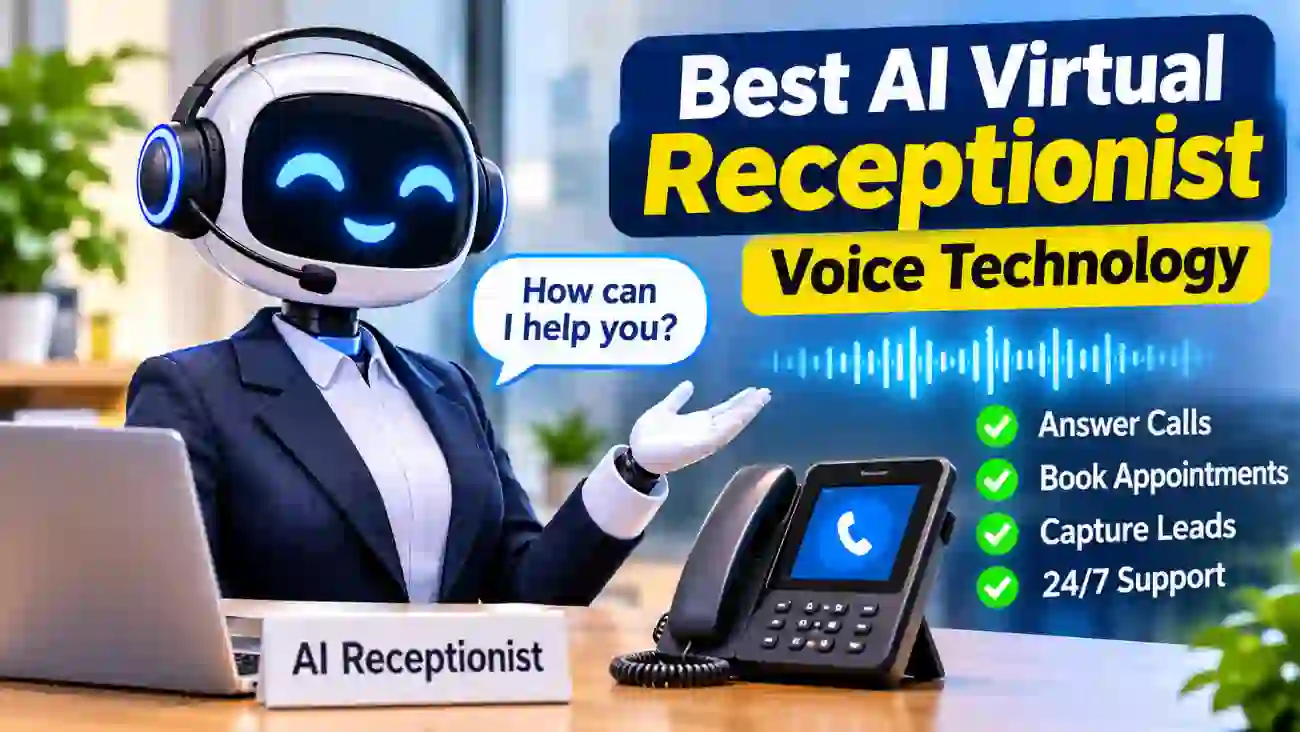
The best AI virtual receptionist voice technology combines natural-sounding speech, real-time conversation, accurate speech recognition, and intelligent call handling. It helps small businesses answer calls, schedule appointments, capture leads, and transfer customers to employees. Popular solutions include Smith.ai, Rosie, Goodcall, RingCentral, and customizable platforms such as Retell AI.
Best AI Virtual Receptionist Voice Technology: 10 Options for Businesses
Key Takeaways
- AI virtual receptionists use voice technology to answer business calls automatically.
- Natural-sounding speech makes customer conversations more comfortable.
- Speech recognition and natural language processing help AI understand callers.
- The right technology can handle appointments, customer questions, and lead capture.
- Businesses should compare voice quality, integrations, pricing, and human handoff options.
Introduction
The best AI virtual receptionist voice technology helps businesses manage phone calls without requiring someone to answer every call manually. It uses artificial intelligence to understand spoken questions, respond naturally, and complete common customer service tasks.
Many small businesses struggle with missed calls, busy employees, and customer inquiries outside regular working hours. Traditional answering services can help, but they may require additional staff and ongoing expenses.
AI voice technology offers another option. It allows businesses to create virtual receptionists that communicate with callers, provide information, schedule appointments, and transfer important calls.
However, not every AI receptionist sounds natural or understands customers equally well. Some focus on simple call answering, while others offer advanced conversational features and business integrations.
This guide explores 10 AI receptionist platforms and voice technology options, explains their important features, and helps business owners choose a solution that fits their needs.
What Does “Best AI Virtual Receptionist Voice Technology” Mean?
The best AI virtual receptionist voice technology refers to artificial intelligence systems that communicate with customers through spoken conversations.
These systems combine several technologies, including automatic speech recognition (ASR), natural language processing (NLP), large language models (LLMs), and text-to-speech (TTS).
Together, these technologies allow a virtual receptionist to listen, understand questions, and respond using a natural-sounding voice.
Businesses commonly use this technology for:
- Answering incoming customer calls.
- Scheduling and confirming appointments.
- Sharing business hours and service information.
- Collecting customer contact details.
- Routing calls to the right department.
- Providing after-hours phone support.
- Capturing potential sales leads.
Unlike traditional automated phone menus, modern AI receptionists can support more flexible conversations.
Why Use AI Virtual Receptionist Voice Technology?
A business phone call can create a valuable sales opportunity. However, customers may contact another company when nobody answers.
AI virtual receptionists help businesses provide consistent phone coverage without depending entirely on employees.
Here are some important benefits:
- Reduce missed calls: Answer customer inquiries even when employees are busy.
- Improve customer experience: Offer natural conversations instead of complicated phone menus.
- Save time: Automate repetitive questions and appointment requests.
- Capture more leads: Collect customer names, phone numbers, and service requirements.
- Provide extended coverage: Handle calls outside normal business hours.
- Improve call management: Send callers to the appropriate employee or department.
The technology is especially useful for home services, healthcare administration, professional services, restaurants, and local businesses.
10 Best AI Virtual Receptionist Voice Technology Options
The following platforms offer different approaches to AI-powered phone communication. Some provide ready-made receptionist services, while others give businesses tools to build customized voice agents.
1. Smith.ai
AI with human backup
Overview
Smith.ai combines artificial intelligence with human receptionist support. Its technology can answer calls, collect customer information, qualify leads, and help manage appointment requests.
One important feature is its human backup option. Businesses can use live receptionists when a caller needs additional assistance.
Best For
- Professional
- Formal
- Businesses needing human support
Example 1:
A law firm can use Smith.ai to collect information from potential clients before forwarding qualified inquiries.
Example 2:
A consulting company can use its receptionist service to handle incoming calls when employees are unavailable.
Quick Tip:
Consider Smith.ai when your business needs more than automated conversations and values access to human assistance.
2. Rosie
Overview
Rosie provides an AI receptionist designed for small businesses and service professionals.
It can learn business information from sources such as a company’s website and Google Business Profile. Its features include answering questions, capturing leads, and handling appointment-related conversations.
Best For
- Friendly
- Casual
- Small businesses and contractors
Example 1:
A plumbing company can use Rosie to answer questions about service availability.
Example 2:
A landscaping business can use it to collect customer details while employees work at different job sites.
Quick Tip:
Check its calendar integrations and call-transfer options before choosing a subscription.
3. Goodcall
Overview
Goodcall offers AI-powered phone answering and automated customer conversations.
Its technology can respond to common questions, collect customer information, and follow customized call workflows. Businesses can also configure how the receptionist handles different caller requests.
Best For
- Professional
- Friendly
- Local service businesses
Example 1:
A cleaning company can use Goodcall to collect details about residential cleaning requests.
Example 2:
A repair shop can configure its receptionist to answer questions about operating hours and service availability.
Quick Tip:
Review its unique-customer pricing model to understand how your monthly expenses may change.
4. RingCentral AI Receptionist
Overview
RingCentral AI Receptionist provides automated call answering for businesses.
It can respond to customer questions, capture information, route calls, and connect with business communication workflows. Its connection with the broader RingCentral phone ecosystem can be useful for companies already using its services.
Best For
- Professional
- Formal
- Growing businesses
Example 1:
A real estate office can use it to direct property inquiries to the appropriate agent.
Example 2:
A multi-department business can use automated routing to manage incoming customer calls.
Quick Tip:
Compare the standalone service with the RingEX add-on to determine which setup fits your existing phone system.
5. My AI Front Desk
Overview
My AI Front Desk provides automated phone answering alongside additional communication features.
Its technology helps businesses answer questions, manage appointment requests, and follow up with customers through text messages. This makes it useful for businesses that want to connect phone conversations with other customer interactions.
Best For
- Friendly
- Casual
- Small service businesses
Example 1:
A beauty salon can use it to respond to booking questions and share appointment information.
Example 2:
A local repair business can send text follow-ups after receiving a customer inquiry.
Quick Tip:
Check the included voice minutes and additional usage charges before estimating your monthly costs.
6. Slang.ai
Overview
Slang.ai focuses on AI-powered phone communication for restaurants.
It helps restaurant teams manage incoming calls and common customer requests. Its restaurant-focused approach makes it relevant for businesses handling reservations and dining inquiries.
Best For
- Friendly
- Casual
- Restaurants and hospitality businesses
Example 1:
A restaurant can use Slang.ai to answer questions about its menu and operating hours.
Example 2:
A dining establishment can use automated phone assistance to manage reservation-related inquiries.
Quick Tip:
Restaurant owners should check which reservation systems and ordering workflows the platform supports.
7. Telnyx AI Agents
Overview
Telnyx offers programmable voice technology through its AI agent platform.
Unlike simple ready-made receptionist services, Telnyx gives businesses more control over how their voice agents communicate and operate. Developers can build customized workflows for answering questions, routing calls, and connecting business systems.
Best For
- Professional
- Formal
- Businesses with technical teams
Example 1:
A technology company can create a voice agent that answers product questions using its internal knowledge base.
Example 2:
A service company can build customized call-routing workflows for different departments.
Quick Tip:
Choose a programmable platform when your business needs custom workflows and has the technical resources to maintain them.
8. Synthflow AI
Overview
Synthflow AI helps businesses create conversational AI voice agents.
Its visual workflow tools allow users to design automated phone conversations without building every component from scratch. Businesses can customize how the AI responds and connects with other systems.
Best For
- Professional
- Friendly
- Businesses needing customization
Example 1:
A home improvement company can create a voice agent that collects project details from potential customers.
Example 2:
A service provider can build an automated appointment-confirmation workflow.
Quick Tip:
Test the complete conversation flow before connecting the agent to your primary business phone number.
9. Retell AI
Overview
Retell AI provides tools for creating and managing AI-powered phone agents.
Its platform supports customized conversational workflows, voice selection, and integrations. It is particularly relevant for businesses that want greater control over their AI phone experience.
Best For
- Professional
- Formal
- Developers and growing companies
Example 1:
A healthcare administration company can develop an agent to handle nonclinical appointment inquiries.
Example 2:
A customer support team can build a voice assistant that collects information before transferring complex requests.
Quick Tip:
Test response speed, interruption handling, and call transfers during development.
10. ElevenLabs Conversational AI
Overview
ElevenLabs provides advanced voice generation and conversational AI technology.
Its voice capabilities help developers create natural-sounding digital conversations with different voice styles and language options. Businesses can use its conversational tools to build customized voice experiences.
Best For
- Friendly
- Professional
- Businesses prioritizing voice quality
Example 1:
A customer service company can create a branded virtual assistant with a consistent speaking style.
Example 2:
An international business can develop voice experiences for customers who speak different languages.
Quick Tip:
Evaluate voice clarity, language support, and conversation quality instead of choosing a platform based on voice samples alone.
Comparison Table
Here is a quick comparison of the 10 platforms and their primary uses.
| Alternative | Best Used In | Tone |
|---|---|---|
| Smith.ai | Human-assisted call answering | Professional |
| Rosie | Small business call management | Friendly |
| Goodcall | Local service businesses | Professional |
| RingCentral | Business phone systems | Formal |
| My AI Front Desk | Calls and text follow-ups | Friendly |
| Slang.ai | Restaurant phone support | Casual |
| Telnyx | Custom voice agent development | Professional |
| Synthflow AI | Custom AI workflows | Professional |
| Retell AI | Advanced voice automation | Formal |
| ElevenLabs | Natural voice experiences | Friendly |
Note: These are different products and technology platforms, not identical services. Features, integrations, and pricing depend on the selected plan.
Common Mistakes When Choosing AI Receptionist Technology
Choosing an AI receptionist requires more than finding a voice that sounds realistic. Businesses should consider how well the complete system handles customer conversations.
Here are five common mistakes to avoid.
1. Choosing voice quality over accuracy: A realistic voice is useful, but the system must also understand questions and provide correct information.
2. Ignoring call transfers: Some customers need human assistance. Always check whether the platform supports reliable call transfers.
3. Overlooking integrations: A receptionist that cannot connect with your calendar or CRM may create extra work for employees.
4. Forgetting usage costs: Monthly subscriptions may include limited minutes, calls, or interactions. Review overage charges before purchasing.
5. Not testing real conversations: Test interruptions, background noise, unclear questions, and unusual requests before launching the service.
Frequently Asked Questions
1. What is the best AI virtual receptionist voice technology?
The best option depends on your business requirements. Smith.ai offers AI with human receptionist backup, Rosie focuses on small business call handling, and Goodcall supports automated customer conversations. Developers seeking customized voice experiences can explore Retell AI, Synthflow, and Telnyx.
2. How does AI virtual receptionist voice technology work?
AI receptionists use speech recognition to convert spoken words into information that an AI system can understand. Natural language processing helps identify the caller’s request, while text-to-speech technology generates a spoken response. Connected business tools can also help the receptionist book appointments and transfer calls.
3. Can an AI virtual receptionist sound like a real person?
Yes. Modern AI voice technology can produce natural-sounding speech with realistic pacing, pronunciation, and conversational responses. However, voice quality varies between platforms. Businesses should test actual phone conversations because background noise, interruptions, and unusual questions can affect the experience.
4. How much does an AI virtual receptionist cost?
Pricing depends on the provider, included minutes, call volume, and available features. Some services offer monthly subscriptions, while others charge per call or minute. Businesses should compare the total expected monthly cost, including additional usage, integrations, and setup fees.
5. Can AI receptionists schedule appointments automatically?
Yes. Many AI receptionist platforms support appointment scheduling through connected calendars and booking systems. Depending on the integration, they can check availability, collect customer details, and confirm appointments. Always verify that the platform supports your existing scheduling software.
6. Is AI receptionist technology suitable for small businesses?
Yes. Small businesses can use AI receptionists to manage incoming calls without hiring additional front-desk employees. They are particularly useful for contractors, salons, repair companies, consultants, and other businesses that cannot answer every call immediately.
7. Can AI virtual receptionists understand different languages?
Some AI receptionist platforms support multiple languages and can communicate with customers in their preferred language. However, language coverage and accent recognition vary. Businesses serving multilingual customers should test the exact languages and regional accents their callers use.
8. What features should I look for in AI voice receptionist software?
Look for natural speech, accurate voice recognition, fast responses, appointment scheduling, CRM integrations, lead capture, and reliable call transfers. Security and data handling also matter, particularly for businesses working with confidential customer information. Choose features based on your actual daily phone needs.
Conclusion
The best AI virtual receptionist voice technology can help businesses improve phone communication, reduce missed opportunities, and manage customer inquiries more efficiently. However, the right solution depends on your call volume, budget, industry, and existing business software.
Small businesses looking for ready-made services can explore Rosie, Goodcall, My AI Front Desk, and Smith.ai. Companies already using a business phone system may prefer RingCentral, while developers can consider Telnyx, Synthflow, or Retell AI for customized workflows.
Voice quality should also play an important role in your decision. A receptionist should understand different speaking styles, respond quickly, and provide accurate information.

Jack London is a writer with a lifelong love for honest emotion and powerful words. On MessegeType, he creates heartfelt messages for every occasion — words meant to be remembered, shared, and felt.