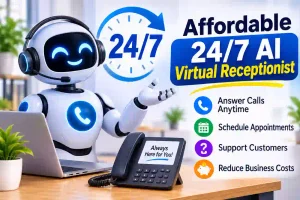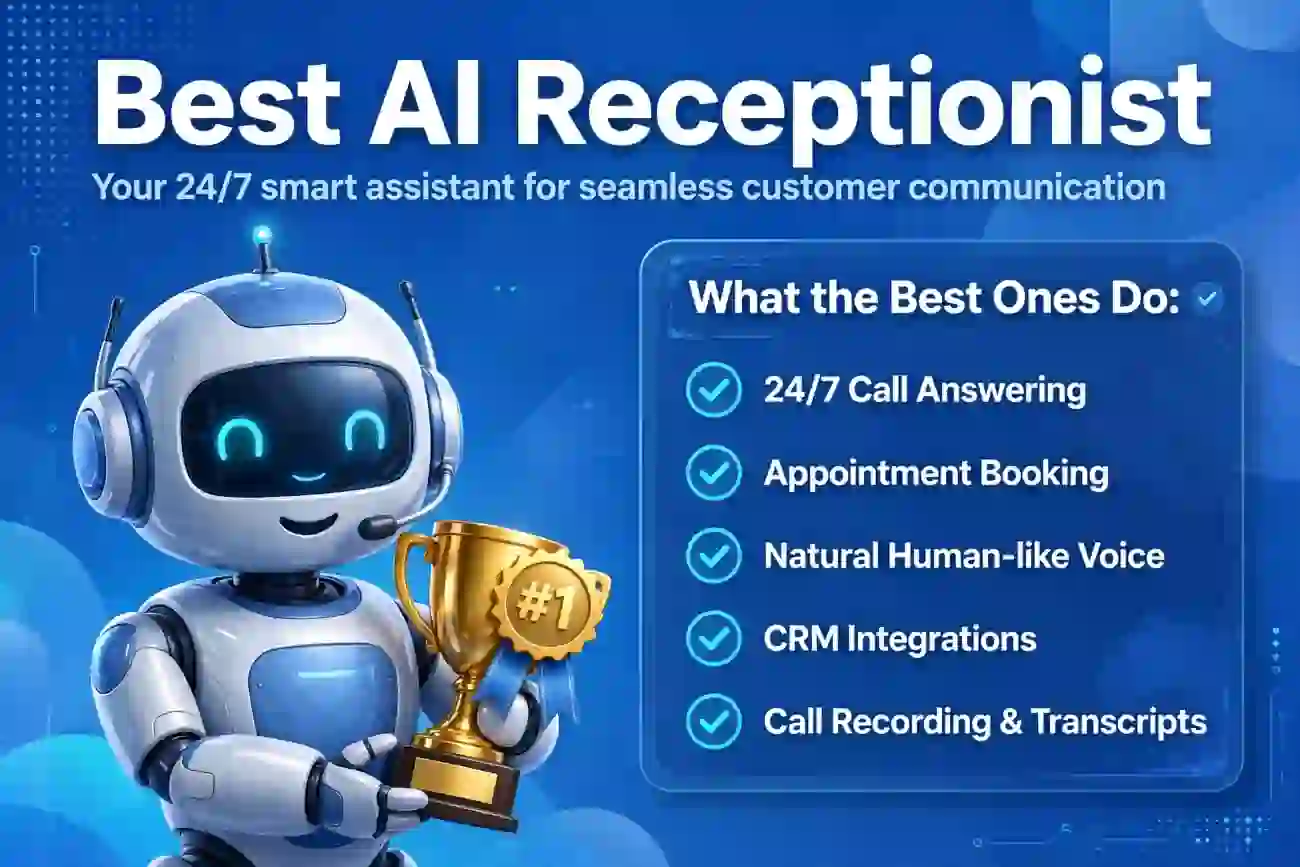
The best AI receptionist is an AI-powered phone assistant that answers calls, responds to common questions, schedules appointments, and captures leads automatically. Businesses can use AI receptionist software to provide 24/7 customer support, reduce missed calls, and manage routine tasks without hiring additional front-desk staff.
Key Takeaways
- AI receptionists answer business calls and handle routine customer requests automatically.
- The best solution depends on your budget, industry, call volume, and required features.
- Small businesses can use AI receptionists to capture leads and schedule appointments.
- Essential features include natural-sounding voices, call transfers, integrations, and reporting.
- Always test call quality, privacy controls, and pricing before choosing a provider.
best ai receptionist
Introduction
Finding the best AI receptionist can help your business answer more calls, support customers, and manage daily tasks with less manual work. These tools use artificial intelligence to speak with callers, understand their requests, and respond based on your business information.
Many businesses miss calls while employees serve customers, attend meetings, or work outside the office. Hiring a full-time receptionist may also be expensive for a small company with a limited budget.
An AI receptionist offers another option. It can answer incoming calls, collect customer details, book appointments, and transfer callers to the right person when needed.
However, not every service offers the same features or level of control. Some focus on simple call answering, while others support scheduling, customer relationship management (CRM) integrations, and advanced call handling.
This guide explains what to look for, compares 10 AI receptionist services, and helps you choose a solution that fits your business needs.
What Does “Best AI Receptionist” Mean?
The term best AI receptionist refers to an AI-powered service that manages business phone calls and routine receptionist tasks effectively. It uses voice recognition, language processing, and automated workflows to communicate with callers.
Businesses commonly use these tools to:
- Answer calls during business hours or after closing.
- Respond to frequently asked questions.
- Schedule, confirm, or change appointments.
- Collect names, phone numbers, and other lead details.
- Transfer important calls to employees.
- Provide basic information about products and services.
The right solution depends on your needs. A dental office may prioritize appointment scheduling, while a home services company may need emergency call routing and lead capture.
Why Use an AI Receptionist?
An AI receptionist can improve call coverage without requiring an employee to answer every incoming call. It can also make routine communication easier to manage.
Benefits include:
- Fewer missed calls: Answer customers when your team is busy.
- Extended availability: Provide support outside normal office hours.
- Lower staffing pressure: Automate repetitive receptionist tasks.
- Faster responses: Give callers immediate answers to common questions.
- Better lead capture: Collect contact details before potential customers hang up.
- More consistent service: Follow defined scripts and business rules.
These benefits depend on how well the service is configured. Complicated requests, upset callers, and unusual situations may still require a human employee.
10 Best AI Receptionist Services
The following providers offer different approaches to automated phone answering. They are not presented as a definitive performance ranking; compare their current plans, integrations, and capabilities before purchasing.
1. Smith.ai
Best for:
Businesses that want AI-assisted call handling with access to human receptionist services.
Smith.ai offers AI receptionist capabilities alongside live virtual receptionist services. Depending on the plan, businesses can use it to handle incoming calls, screen callers, capture leads, and transfer conversations.
Its combination of automated and human support may suit professional service firms that want additional help with complex inquiries.
Consider it if:
You need an option for calls that require a personal touch.
Check before buying:
Confirm which AI features, human support options, and call volumes your chosen plan includes.
2. Goodcall
Best for:
Small businesses that need automated phone answering.
Goodcall provides AI phone agents that can answer common questions and guide callers through predefined business workflows. Businesses can configure the system around their services, operating hours, and customer needs.
It may be useful for local service providers that want to reduce repetitive calls without managing a complicated contact center.
Consider it if:
You want an AI agent focused on handling everyday customer calls.
Check before buying:
Review current usage limits, setup requirements, and available integrations.
3. Dialzara
Best for:
Small businesses looking for a virtual receptionist experience.
Dialzara provides AI-powered call answering designed to help businesses respond to callers, collect information, and handle common inquiries. It can support companies that need a more consistent phone presence without adding another employee.
The service may suit businesses that receive regular inquiries but do not need a large customer support team.
Consider it if:
You want to automate basic receptionist tasks.
Check before buying:
Test how it handles interruptions, unclear questions, and calls that need a human.
4. My AI Front Desk
Best for:
Appointment-based businesses.
My AI Front Desk focuses on AI receptionist functions such as answering calls, managing appointment requests, and responding to business-specific questions. These capabilities can help service providers manage inquiries while working with existing customers.
Businesses should assess whether its scheduling workflows match their actual appointment process.
Consider it if:
Your team spends significant time answering repetitive questions and booking appointments.
Check before buying:
Verify calendar compatibility, appointment rules, and human handoff options.
5. Rosie
Best for:
Small businesses that need help answering calls when employees are unavailable.
Rosie offers an AI receptionist service designed to answer business calls and respond using information about the company. It can help businesses maintain phone coverage when staff are occupied or the office is closed.
It may be particularly useful for companies that need basic customer communication rather than a full contact center.
Consider it if:
Your main problem is missed calls and routine customer questions.
Check before buying:
Confirm current plan limits and the level of customization available.
6. Retell AI
Best for:
Businesses and developers building customized voice agents.
Retell AI provides infrastructure for creating AI voice agents that can conduct phone conversations and connect with external systems. It offers more flexibility for businesses that want tailored call flows rather than a simple, ready-made receptionist.
However, customization may require technical setup, integration work, and ongoing testing.
Consider it if:
You need customized call logic or integrations with business software.
Check before buying:
Calculate total costs, including usage, telephony, integrations, and development.
7. Vapi
Best for:
Teams that want to build and manage custom AI phone agents.
Vapi provides a developer-focused platform for building voice AI applications. Businesses can use it to create phone agents that follow specific instructions, connect with tools, and support customized workflows.
It offers flexibility but may not be the easiest starting point for someone who simply wants to activate a receptionist with minimal configuration.
Consider it if:
Your company has technical resources and needs greater control over its voice AI system.
Check before buying:
Review the implementation effort, usage costs, and reliability of your planned integrations.
8. Bland AI
Best for:
Businesses exploring automated phone conversations at scale.
Bland AI provides tools for building AI-powered phone agents and automating voice interactions. Depending on the implementation, businesses can use it for inbound call handling, outbound conversations, and customized communication workflows.
Its flexibility makes it worth evaluating for companies with more specialized automation needs.
Consider it if:
You need voice automation beyond a standard receptionist workflow.
Check before buying:
Confirm inbound capabilities, compliance requirements, and the technical resources needed for setup.
9. Synthflow AI
Best for:
Businesses that want to create voice AI workflows with limited coding.
Synthflow AI offers a platform for building conversational voice agents and automating phone-based interactions. Businesses can configure agents for tasks such as qualifying leads, answering questions, and routing conversations.
Its suitability depends on the complexity of your workflow and the integrations you need.
Consider it if:
You want customizable voice automation without building every component from scratch.
Check before buying:
Test call quality, workflow limits, integration options, and pricing for your expected call volume.
10. Aircall
Best for:
Businesses that want an integrated business phone system.
Aircall is a cloud-based business phone platform with call management, team collaboration, and integrations. Its core offering differs from a dedicated AI receptionist, so businesses should verify which AI answering or voice automation capabilities are available through current features or connected solutions.
It may be appropriate when your business needs a broader phone system rather than an independent AI answering service.
Consider it if:
You need shared business numbers, team call routing, and CRM-connected communications.
Check before buying:
Confirm whether the specific AI receptionist workflow you need is built in or requires another product.
Comparison Table
| AI receptionist service | Best used for | General focus |
|---|---|---|
| Smith.ai | Professional services | AI and human reception |
| Goodcall | Local small businesses | Automated call answering |
| Dialzara | Small companies | Virtual receptionist tasks |
| My AI Front Desk | Appointment-based businesses | Calls and scheduling |
| Rosie | Small businesses | Routine call handling |
| Retell AI | Developers and businesses | Custom voice agents |
| Vapi | Technical teams | Programmable voice AI |
| Bland AI | Advanced automation | Phone conversation workflows |
| Synthflow AI | Custom workflow builders | Low-code voice automation |
| Aircall | Growing teams | Business phone management |
Features and plans can change. Verify current capabilities, integrations, and pricing directly with each provider.
Common Mistakes When Choosing an AI Receptionist
1. Choosing Based Only on Price
A low monthly price may not include enough calls, integrations, or advanced features. Calculate the total cost based on your expected usage.
2. Ignoring Human Call Transfers
Some customers need help that an AI cannot provide. Choose a service that can transfer callers to the appropriate employee or offer a clear alternative.
3. Overlooking Scheduling Requirements
Not every receptionist integrates with every calendar or booking platform. Confirm that the service can follow your actual appointment rules.
4. Forgetting Privacy and Compliance
Calls may contain personal, financial, or other sensitive information. Review data retention, recording consent, access controls, and applicable privacy requirements before deployment.
5. Skipping Real-World Testing
A demo may not reflect everyday calls. Test background noise, accents, interruptions, complicated questions, and urgent requests before directing all business calls to the system.
Frequently Asked Questions
1. What is the best AI receptionist for a small business?
The best option depends on your business needs. Goodcall, Dialzara, Rosie, and My AI Front Desk are options to investigate for routine call answering and receptionist tasks. Compare setup requirements, appointment features, usage limits, and total cost before choosing.
2. Can an AI receptionist answer calls 24/7?
Many AI receptionist services can answer calls outside normal business hours, including nights and weekends. However, availability depends on the provider, configuration, phone routing, and service status. Confirm that the plan supports continuous call coverage and decide how urgent calls should reach a human.
3. How much does an AI receptionist cost?
Pricing varies by provider and may depend on monthly subscriptions, call minutes, usage, features, or additional services. Some platforms charge separately for telephony and integrations. Compare the expected monthly cost for your actual call volume rather than relying on a starting price alone.
4. Can an AI receptionist schedule appointments?
Yes, some AI receptionists can schedule appointments, check availability, and manage booking requests. These functions depend on calendar integrations and the provider’s supported workflows. Before purchasing, test whether the service can handle cancellations, rescheduling, appointment types, and business-specific scheduling rules.
5. Are AI receptionists better than human receptionists?
AI receptionists can handle repetitive calls consistently and provide extended availability. Human receptionists offer judgment, empathy, and flexibility in complex situations. Many businesses benefit from combining the two, allowing AI to manage routine requests while employees handle sensitive or unusual conversations.
6. Which AI receptionist is easiest to set up?
Ready-made receptionist services are generally worth considering when you want a simpler setup. Developer platforms such as Retell AI and Vapi provide greater customization but may require technical work. Request a demonstration and confirm the setup process before committing to a subscription.
7. Can an AI receptionist work with my existing business phone number?
Some providers support forwarding calls from an existing number, while others may offer number porting or require a separate number. Availability varies by service and carrier. Ask the provider how to connect your current phone system and whether the change affects voicemail, routing, or caller ID.
8. Is an AI receptionist suitable for medical or legal offices?
It can help with administrative tasks such as routing calls, sharing approved information, and managing appointments. However, medical and legal offices must carefully assess confidentiality, data handling, and applicable regulatory obligations. Confirm that the service supports your compliance needs before allowing it to handle sensitive information.
Conclusion
The best AI receptionist for your business is the one that solves your most important phone-handling problems without adding unnecessary complexity. If you need routine call answering, start by evaluating services such as Goodcall, Dialzara, Rosie, or My AI Front Desk. Businesses that want a combination of AI and human support can investigate Smith.ai.
For customized voice workflows, Retell AI, Vapi, Bland AI, and Synthflow AI offer different approaches to building voice agents. Aircall is worth considering if your primary need is a broader business phone system with team collaboration and integrations.
Before making a decision, test each shortlisted service with realistic calls. Check pricing, appointment scheduling, call transfers, privacy controls, and integration support.

Nicholas Sparks is a storyteller who believes the right words at the right moment can change everything. For MessegeType, he writes warm, heartfelt messages for birthdays, love, and life’s special occasions — words meant to be shared with the people who matter most.