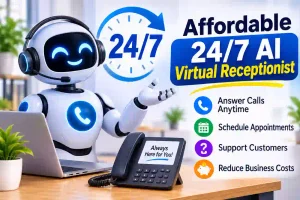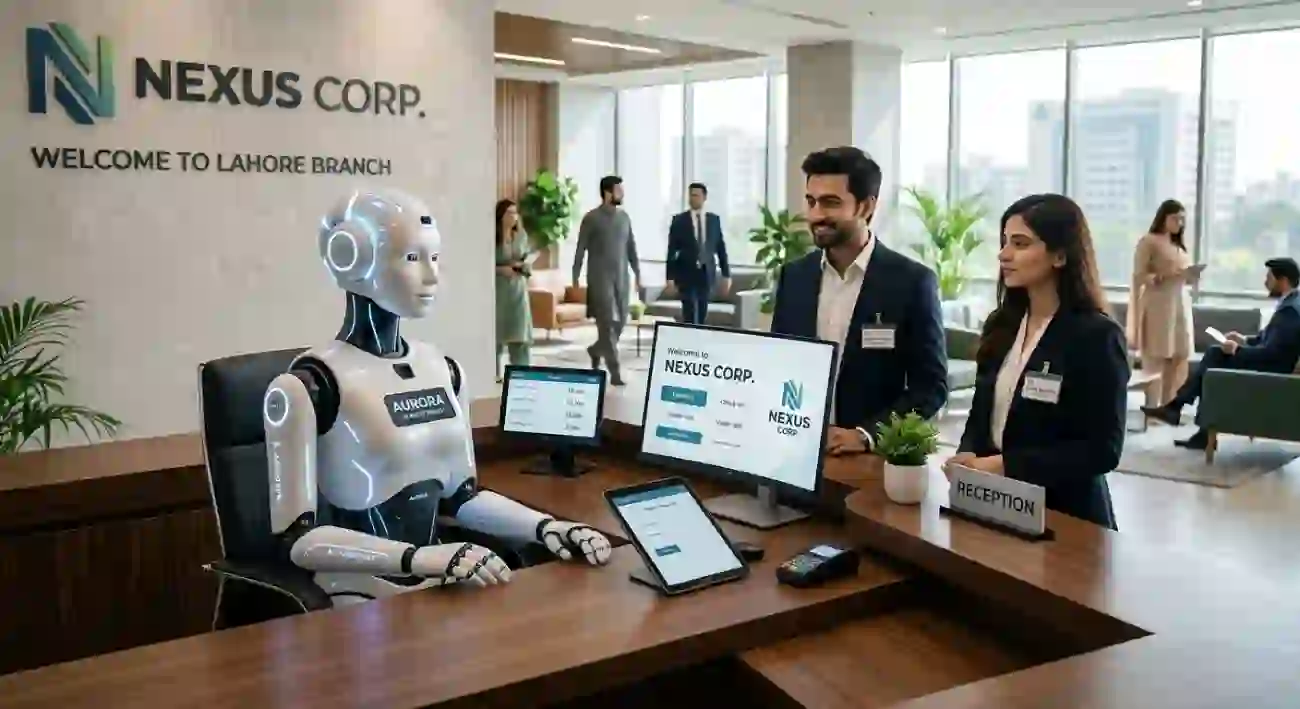
An AI receptionist for business is a virtual phone assistant that answers incoming calls, responds to common questions, schedules appointments, captures leads, and routes calls to the right employees. It helps businesses manage customer communication around the clock, reduce missed calls, and provide faster service without hiring additional front-desk staff.
Key Takeaways
- An AI receptionist answers business calls automatically using conversational voice technology.
- Small businesses can use it to handle customer questions, appointments, and new leads.
- It can provide 24/7 call coverage, including evenings, weekends, and holidays.
- AI receptionists can connect with calendars, CRM platforms, and business phone systems.
- Choosing the right solution depends on call volume, features, integrations, and pricing.
AI Receptionist for Business
Introduction
Every business needs a reliable way to communicate with customers. However, answering every phone call can become difficult when employees are busy serving customers, completing orders, or handling daily operations.
An AI receptionist for business offers a practical way to manage incoming calls without depending entirely on a human receptionist. It uses artificial intelligence and voice technology to answer questions, collect customer information, schedule appointments, and direct callers to the right department.
Businesses of different sizes can use this technology to improve their phone support and reduce missed opportunities. It can also help teams spend less time answering repetitive questions.
In this guide, you’ll learn what an AI receptionist does, why businesses use one, and ten alternative terms for this technology. You’ll also discover its common applications, benefits, and important features to consider before choosing a solution.
What Does “AI Receptionist for Business” Mean?
An AI receptionist for business is an automated phone assistant that uses artificial intelligence to communicate with callers. It can understand spoken questions, provide relevant answers, and complete simple tasks during a phone conversation.
Unlike a traditional answering machine, an AI receptionist can hold interactive conversations. Customers can explain what they need instead of listening to a list of recorded options.
Businesses commonly use this technology for:
- Answering incoming customer calls.
- Booking and confirming appointments.
- Collecting contact information from potential customers.
- Responding to frequently asked questions.
- Transferring calls to employees or departments.
- Providing business hours and location details.
- Handling calls outside regular working hours.
For example, a dental office can use an AI receptionist to schedule appointments, while a home service company can collect information about plumbing or electrical problems.
Why Use Other Ways to Say “AI Receptionist for Business”?
Using alternative terms helps businesses describe this technology more clearly to different audiences. It also makes website content, advertisements, service pages, and customer conversations sound more natural.
Here are some reasons to use alternative phrases:
- Avoid repetition: Use different expressions throughout website pages and marketing materials.
- Improve clarity: Explain the technology in words customers already understand.
- Match search intent: Reach people searching for automated phone answering or virtual reception services.
- Sound professional: Choose terminology that fits business proposals and presentations.
- Reach different audiences: Explain the same service to small businesses, healthcare offices, and service companies.
10 Best Other Ways to Say “AI Receptionist for Business”
The following alternatives describe similar technology. Some focus on its phone-answering abilities, while others highlight automation, customer service, or virtual assistance.
1. AI Virtual Receptionist
Meaning
An AI virtual receptionist is a digital assistant that performs common receptionist duties through artificial intelligence. It can answer calls, greet customers, schedule appointments, and provide basic business information.
Best For
- Professional
- Friendly
- Business websites
Example 1
“Our AI virtual receptionist helps customers book appointments without waiting for an available employee.”
Example 2
“Small medical practices can use an AI virtual receptionist to manage routine phone inquiries.”
Quick Tip
Use this phrase when explaining an AI receptionist service to customers who are already familiar with virtual assistants.
2. AI Phone Answering Service
Meaning
An AI phone answering service automatically answers incoming business calls using voice recognition and conversational AI. It helps businesses respond to callers even when their employees cannot pick up the phone.
Best For
- Professional
- Formal
- Business marketing
Example 1
“Our AI phone answering service handles customer inquiries throughout the day and night.”
Example 2
“The company introduced an AI phone answering service to reduce missed calls during busy hours.”
Quick Tip
Choose this expression when promoting automated call coverage rather than general receptionist responsibilities.
3. Automated Business Receptionist
Meaning
An automated business receptionist handles routine communication tasks without requiring an employee to answer every call. It can greet callers, collect details, and direct conversations according to predefined business rules.
Best For
- Professional
- Formal
- Technical communication
Example 1
“An automated business receptionist helps our office manage incoming calls more efficiently.”
Example 2
“We installed an automated business receptionist to handle common customer requests.”
Quick Tip
This phrase works well in business proposals and explanations of office automation.
4. AI-Powered Receptionist
Meaning
An AI-powered receptionist uses artificial intelligence to understand callers and respond naturally. Depending on its capabilities, it can recognize customer requests, answer questions, and perform actions during conversations.
Best For
- Professional
- Formal
- Technology marketing
Example 1
“Our AI-powered receptionist provides customers with quick answers about available services.”
Example 2
“The new AI-powered receptionist can transfer complex inquiries to the appropriate team member.”
Quick Tip
Use this term when you want to emphasize the artificial intelligence behind the service.
5. Virtual Phone Assistant
Meaning
A virtual phone assistant is a digital tool that helps businesses manage telephone communication. It can answer calls, provide information, collect messages, and support appointment scheduling.
Best For
- Casual
- Professional
- Friendly
Example 1
“Our virtual phone assistant makes it easier for customers to reach our support team.”
Example 2
“The virtual phone assistant collects caller details before forwarding urgent requests.”
Quick Tip
This is a simple alternative for audiences who may not understand technical AI terminology.
6. Automated Call Answering System
Meaning
An automated call answering system responds to incoming calls without requiring someone to answer each one manually. Advanced AI-based versions can understand spoken requests and provide personalized responses.
Best For
- Formal
- Professional
- Technical communication
Example 1
“The automated call answering system helps our staff manage a high volume of customer inquiries.”
Example 2
“We upgraded our automated call answering system to include appointment scheduling.”
Quick Tip
Use this phrase when discussing the technical side of managing business phone calls.
7. AI Customer Service Assistant
Meaning
An AI customer service assistant helps businesses respond to customer questions and requests through automated conversations. It may support phone calls, website chats, or other communication channels.
Best For
- Professional
- Friendly
- Customer support marketing
Example 1
“Our AI customer service assistant answers common questions about product availability.”
Example 2
“Customers can contact the AI customer service assistant to learn more about our services.”
Quick Tip
Choose this phrase when the technology supports more than traditional receptionist duties.
8. Virtual Front Desk Assistant
Meaning
A virtual front desk assistant performs basic front-office tasks through digital technology. It can greet callers, organize appointments, provide business information, and help direct customer requests.
Best For
- Professional
- Warm
- Healthcare and service businesses
Example 1
“Our virtual front desk assistant helps patients schedule their next visit.”
Example 2
“The salon uses a virtual front desk assistant to manage appointment requests.”
Quick Tip
This phrase is particularly useful for clinics, salons, hotels, and appointment-based businesses.
9. Intelligent Call Management Assistant
Meaning
An intelligent call management assistant uses automation and AI to organize incoming calls. Depending on the platform, it can identify customer needs, prioritize requests, and route calls to the appropriate people.
Best For
- Formal
- Professional
- Corporate communication
Example 1
“Our intelligent call management assistant directs customer calls to the correct department.”
Example 2
“The business introduced an intelligent call management assistant to improve its communication process.”
Quick Tip
Use this expression in technical presentations or when describing advanced call-routing capabilities.
10. AI Business Communication Assistant
Meaning
An AI business communication assistant helps companies manage customer interactions through artificial intelligence. It can support phone answering, message collection, appointment coordination, and other communication tasks.
Best For
- Professional
- Formal
- Business marketing
Example 1
“Our AI business communication assistant helps employees respond to routine customer requests.”
Example 2
“The company uses an AI business communication assistant to organize incoming inquiries.”
Quick Tip
Choose this broader expression when discussing several AI communication features rather than phone answering alone.
Comparison Table
| Alternative | Best Used In | Tone |
|---|---|---|
| AI Virtual Receptionist | Service websites | Professional |
| AI Phone Answering Service | Marketing pages | Professional |
| Automated Business Receptionist | Business proposals | Formal |
| AI-Powered Receptionist | Technology content | Professional |
| Virtual Phone Assistant | General communication | Friendly |
| Automated Call Answering System | Technical explanations | Formal |
| AI Customer Service Assistant | Customer support | Friendly |
| Virtual Front Desk Assistant | Clinics and salons | Warm |
| Intelligent Call Management Assistant | Corporate presentations | Formal |
| AI Business Communication Assistant | Business websites | Professional |
Common Mistakes When Choosing an AI Receptionist Term
Choosing the right phrase is important because different expressions can communicate different features. Avoid these five common mistakes when writing about AI receptionist services.
1. Using Technical Terms With Every Audience
Terms such as intelligent call management assistant may confuse customers who are unfamiliar with AI technology. Use simple expressions like virtual phone assistant when writing for general audiences.
2. Assuming Every AI Receptionist Has the Same Features
Some platforms only answer calls and collect messages, while others support appointment booking, CRM integrations, and call transfers. Always describe the actual features your software provides.
3. Using the Same Phrase Repeatedly
Repeating AI receptionist for business in every paragraph makes content sound unnatural. Use relevant alternatives to improve readability without forcing unrelated keywords into the article.
4. Ignoring the Business Industry
A dental office may prefer virtual front desk assistant, while a home service company may find AI phone answering service more relevant. Match the terminology to the audience.
5. Making Unrealistic Automation Claims
An AI receptionist cannot automatically solve every customer problem. Explain its limitations and make clear when callers can reach a human employee.
Frequently Asked Questions
1. What is an AI receptionist for business?
An AI receptionist for business is software that answers incoming calls and communicates with customers using artificial intelligence. It can handle routine questions, schedule appointments, collect caller information, and transfer calls. Businesses use it to improve phone coverage and reduce the workload on employees.
2. How does an AI receptionist work?
An AI receptionist uses voice recognition, natural language processing, and conversational AI to understand callers. When someone calls a business, the system processes their request and responds using a generated voice. Depending on its integrations, it can also access calendars, create appointments, or transfer calls.
3. Is an AI receptionist suitable for small businesses?
Yes. Small businesses can use AI receptionists to answer calls without hiring additional front-desk employees. They are useful for contractors, salons, dental offices, repair companies, and other service providers. The right system depends on the business’s call volume, budget, and customer service needs.
4. Can an AI receptionist answer calls 24/7?
Many AI receptionist platforms offer 24/7 call answering. This allows customers to receive basic information or leave their details outside normal business hours. However, availability depends on the provider, subscription plan, phone configuration, and any service limitations.
5. What is the difference between an AI receptionist and a virtual receptionist?
A virtual receptionist traditionally refers to a remote human professional who answers calls and performs administrative tasks. An AI receptionist uses artificial intelligence to automate these responsibilities. Both can help businesses manage customer communication, but their operating methods and capabilities are different.
6. Can an AI receptionist schedule appointments?
Yes. Many AI receptionist systems can schedule, confirm, and sometimes reschedule appointments. They may connect with business calendars to check available time slots before booking. Businesses should verify calendar compatibility and configure appointment rules to prevent scheduling conflicts.
7. Which businesses benefit most from AI receptionists?
Businesses that receive regular customer calls can benefit from AI receptionists. Common examples include medical clinics, dental practices, law firms, real estate agencies, restaurants, salons, and home service companies. These businesses often handle repetitive questions, appointment requests, and new customer inquiries.
8. What should I look for when choosing AI receptionist software?
Look for natural voice conversations, reliable call handling, appointment scheduling, call transfers, CRM integrations, and clear pricing. Also check whether the platform supports your existing phone system and offers useful reporting. Security, customer data protection, and access to human support are important considerations.
Conclusion
An AI receptionist for business can help companies manage incoming calls, respond to customer questions, and organize daily communication. It offers an automated way to handle routine receptionist tasks while allowing employees to focus on other responsibilities.
The best alternative phrase depends on what you want to communicate. AI virtual receptionist and AI-powered receptionist work well for general business websites. AI phone answering service is useful when highlighting call coverage, while virtual front desk assistant suits appointment-based businesses.
Before choosing an AI receptionist solution, compare its features, integrations, pricing, and ability to handle real customer conversations. Make sure it can transfer complex requests to a human when necessary.

Jack London is a writer with a lifelong love for honest emotion and powerful words. On MessegeType, he creates heartfelt messages for every occasion — words meant to be remembered, shared, and felt.