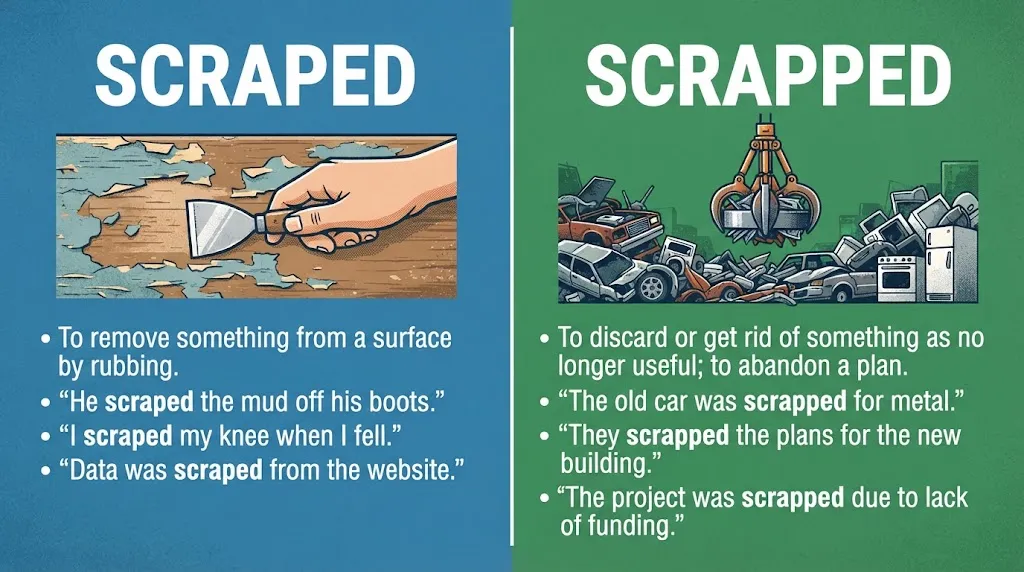
I remember seeing “scraped” and “scrapped” in different sentences and wondering why two almost identical words had completely different meanings. At first, I thought they were just spelling variations.
But when I looked closer, I realized that one can mean removed, collected, or rubbed against something, while the other usually means canceled, discarded, or thrown away. If you have ever mixed them up, you are definitely not alone. The difference is small, but it matters because using the wrong word can change the meaning of your sentence.
Quick Answer: Scraped means rubbed, removed, or collected, while scrapped means canceled, abandoned, or discarded. Both are correct words, but they are used in different situations.
🧠 What Does Scraped vs Scrapped Mean?
The words scraped and scrapped come from two different verbs: scrape and scrap.
Scraped
Scraped is the past tense and past participle of scrape. It can mean removing something from a surface, rubbing against something, or collecting information from a website.
For example:
“I scraped the ice off my car.”
It can also describe a minor injury:
“She scraped her knee while playing outside.”
In technology, scraped can mean collecting data from websites using software.
Scrapped
Scrapped comes from the verb scrap. It usually means to cancel, abandon, reject, or get rid of something.
For example:
“The company scrapped its old plan.”
This means the company decided not to continue with the plan.
In short: Scraped = removed, rubbed, or collected; Scrapped = canceled, abandoned, or discarded.
📱 Where Are Scraped and Scrapped Commonly Used?
Unlike internet slang, scraped and scrapped are standard English words. You may see them in everyday conversations, social media, work messages, news, technology, and writing.
- 💬 Texting: Talking about accidents, cleaning, or plans
- 📱 Social Media: Discussing canceled ideas or projects
- 💻 Technology: “Web scraped data” is common in programming and SEO
- 📰 News: “The government scrapped the proposal”
- 🏢 Work: “The team scrapped the original plan”
- 🛠️ Everyday Life: “I scraped the paint off the wall”
Both words are suitable for casual and formal writing when used correctly.
💬 Examples of Scraped vs Scrapped in Conversation
Here are some realistic examples to make the difference easier to remember.
A: ouch, what happened to your hand?
B: i scraped it on the wall 😭
A: did you finish cleaning the pan?
B: yeah, i scraped all the burnt food off.
A: are you still doing that project?
B: nope, we scrapped the whole idea.
A: why isn’t the event happening anymore?
B: they scrapped it because of the weather.
A: how did you get all that website data?
B: i scraped it using a script.
A: did you keep the old design?
B: nah, we scrapped it and started again.
A: your knee looks painful 😬
B: yeah, i scraped it when i fell.
🕓 When to Use and When Not to Use Scraped vs Scrapped
Because these words have different meanings, choosing the correct one depends on what you are trying to say.
✅ When to Use “Scraped”
Use scraped when you mean:
- Removing something from a surface
- Rubbing against something
- Getting a minor skin injury
- Collecting information or data
- Barely succeeding, especially in phrases like “scraped through”
Example:
“I scraped the sticker off my laptop.”
❌ Don’t Use “Scraped” When You Mean Canceled
If you mean that something was canceled, abandoned, or rejected, use scrapped, not scraped.
❌ “The company scraped the project.”
✅ “The company scrapped the project.”
✅ When to Use “Scrapped”
Use scrapped when you mean:
- Canceling a plan
- Abandoning an idea
- Throwing something away
- Getting rid of an old system
- Deciding not to continue with something
Example:
“They scrapped the original design.”
❌ Don’t Use “Scrapped” for Physical Scraping
If something physically rubs against or removes material from another surface, scraped is normally the correct word.
❌ “I scrapped my knee.”
✅ “I scraped my knee.”
Quick Comparison
| Context | Example Phrase | Why It Works |
| Friend Chat | “I scraped my knee 😭” | Describes a minor injury |
| Cleaning | “I scraped the paint off.” | Means removing material |
| Work Chat | “We scrapped the old plan.” | Means canceled or abandoned |
| “The proposal was scrapped.” | Formal and grammatically correct | |
| Technology | “The website data was scraped.” | Means data was collected |
🔄 Similar Words or Alternatives
| Word | Meaning | When to Use |
| Removed | Took something away | General situations |
| Rubbed | Moved against a surface | Physical contact |
| Collected | Gathered information or things | Data or objects |
| Canceled | Stopped an event or plan | Plans and events |
| Abandoned | Gave up an idea or project | Projects or goals |
| Discarded | Threw something away | Unwanted objects or ideas |
A useful trick is to connect scraped with a surface and scrapped with a plan or object being discarded.
❓ FAQs:
1. What is the difference between scraped and scrapped?
Scraped usually means rubbed, removed, or collected. Scrapped usually means canceled, abandoned, or discarded.
2. Is “scraped” a correct word?
Yes. Scraped is the past tense of scrape.
3. Is “scrapped” a correct word?
Yes. Scrapped is the past tense of scrap.
4. Is it “scraped the project” or “scrapped the project”?
The correct phrase is “scrapped the project” when you mean the project was canceled or abandoned.
5. Is it “scraped my knee” or “scrapped my knee”?
The normal expression is “scraped my knee.”
6. What does scraped mean?
Scraped can mean rubbed against something, removed something from a surface, or collected data.
7. What does scrapped mean?
Scrapped means canceled, abandoned, rejected, or discarded.
8. Does scraped mean collected?
Yes. In technology, scraped can mean information was automatically collected from websites.
9. Does scrapped mean canceled?
Yes. For example, “The plan was scrapped” means the plan was canceled or abandoned.
10. Is scraped formal or casual?
Scraped is a standard English word and can be used in both casual and formal contexts.
11. Is scrapped formal or casual?
Scrapped is also standard English and works in both casual and formal writing.
12. Can scraped describe an injury?
Yes. “I scraped my elbow” means the skin was damaged by rubbing against a rough surface.
13. Can scrapped describe an idea?
Yes. “They scrapped the idea” means they decided not to continue with it.
14. What does web scraped mean?
Web scraped means information has been automatically collected from websites, usually with software.
15. What does “scrape by” mean?
Scrape by means to manage to succeed or survive with very little money, time, or resources.
16. What does “scrap” mean as a noun?
As a noun, scrap can mean a small leftover piece of something or discarded material.
17. Can I say “the event was scrapped”?
Yes. This means the event was canceled or abandoned.
18. Can I say “the wall was scraped”?
Yes. It can mean the wall was rubbed, scratched, or had material removed from its surface, depending on context.
19. How can I remember scraped vs scrapped?
Think scraped = surface and scrapped = stopped. This simple connection can help you remember the difference.
20. Which is correct: scraped or scrapped?
Both are correct, but they have different meanings. Use scraped for rubbing, removing, or collecting and scrapped for canceling, abandoning, or discarding.
Conclusion
Understanding scraped vs scrapped is easier when you focus on their different meanings. Scraped usually means rubbing or removing something from a surface, such as scraped paint, or collecting information from a website. Scrapped, on the other hand, means canceled, abandoned, or thrown away as useless or unwanted.
A simple way to remember the difference is: scraped = removed or collected, while scrapped = canceled or discarded. Once you know this small distinction, choosing the correct word in writing becomes much easier. Whether you are talking about a scraped knee, scraped data, or a scrapped plan, using the right spelling helps make your meaning clear.

Nicholas Sparks is a storyteller who believes the right words at the right moment can change everything. For MessegeType, he writes warm, heartfelt messages for birthdays, love, and life’s special occasions — words meant to be shared with the people who matter most.