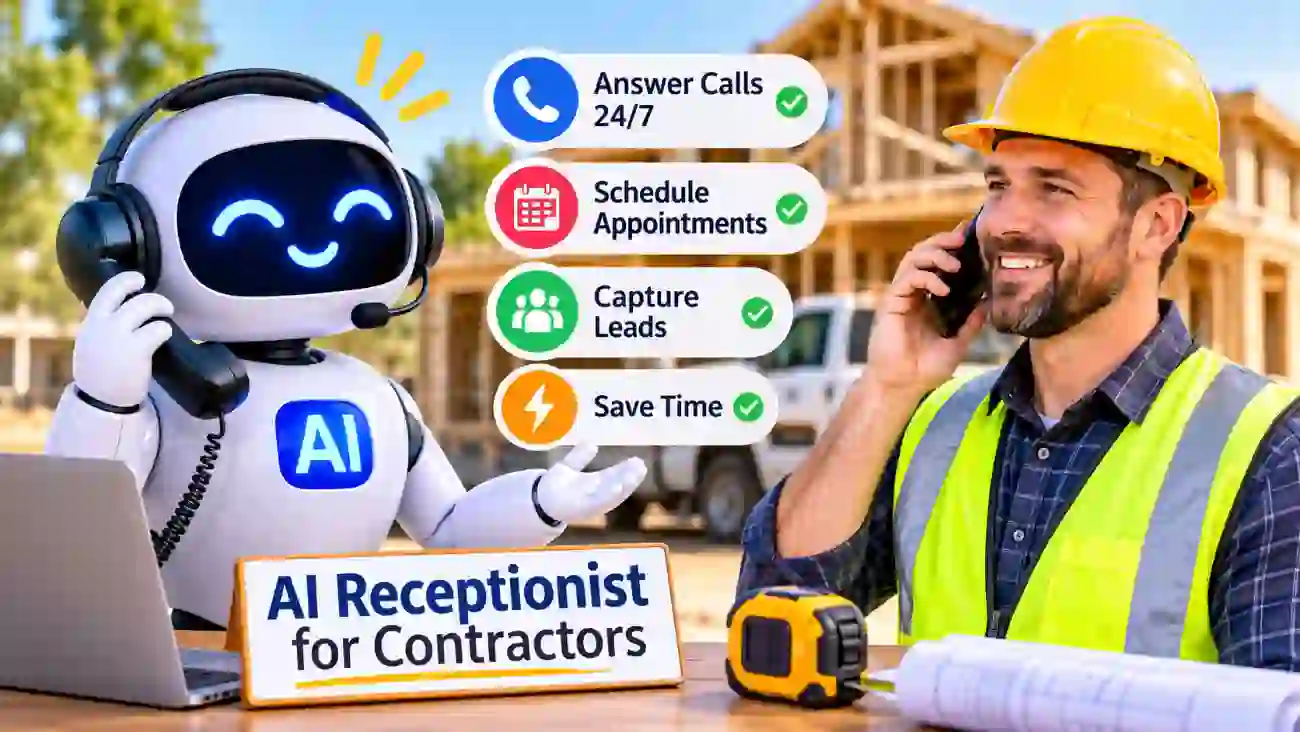
An AI receptionist for contractors is a virtual phone assistant that answers customer calls, collects project details, schedules estimates, and handles service requests. It helps contractors capture more leads, reduce missed calls, and provide 24/7 customer support without hiring additional office staff.
Key Takeaways
- An AI receptionist answers contractor calls around the clock, even when workers are on job sites.
- It collects customer information, qualifies leads, and schedules estimates or appointments.
- HVAC companies, plumbers, electricians, roofers, and general contractors can benefit from AI phone support.
- AI receptionists can reduce administrative work and help businesses respond to new leads faster.
- Contractors should choose a system with reliable call handling, scheduling, CRM integration, and human call transfers.
AI Receptionist for Contractors: Benefits, Features, and Costs
Introduction
Contractors spend much of their day working on job sites, meeting customers, managing projects, and handling urgent service requests. Answering every incoming phone call during these activities can be difficult. Unfortunately, a missed call could mean losing a new customer to another contractor.
An AI receptionist for contractors helps solve this problem by answering business calls automatically. It can greet callers, understand their needs, collect contact details, schedule appointments, and send important information to the business owner.
Unlike traditional answering services, AI receptionists use voice technology to handle common conversations without requiring someone to answer every call. They can also provide support outside normal business hours.
In this guide, you’ll learn how AI receptionists work, which features contractors should look for, how much they cost, and how to choose the right solution for your business.
What Is an AI Receptionist for Contractors?
An AI receptionist for contractors is an automated phone assistant designed to manage customer calls for construction and home service businesses. It uses artificial intelligence and voice recognition to understand callers and respond naturally.
Instead of sending every call to voicemail, the system answers the phone, asks relevant questions, and performs basic office tasks.
For example, a homeowner might call a plumbing company about a leaking pipe. The AI receptionist can ask about the problem, collect the property address, identify the urgency, and notify the plumber.
Contractors commonly use this technology in businesses such as:
- HVAC installation and repair companies.
- Plumbing and drain cleaning businesses.
- Electrical contractors.
- Roofing and siding companies.
- General construction businesses.
- Painting and remodeling contractors.
- Landscaping and home improvement companies.
The main purpose is simple: help contractors stay connected with customers while spending less time managing phone calls.
Why Do Contractors Need an AI Receptionist?
Running a contracting business involves more than completing projects. Owners must answer questions, manage schedules, respond to new leads, and communicate with existing customers.
When calls go unanswered, potential customers may contact competitors instead.
Here are some reasons contractors consider AI receptionists.
1. Stop Missing Important Customer Calls
Contractors often work with power tools, heavy equipment, and other noisy machinery. Answering a phone call may not be possible during these activities.
An AI receptionist can answer incoming calls while the contractor continues working.
This gives potential customers a way to reach the business instead of hearing a voicemail message.
2. Provide 24/7 Phone Support
Customers don’t always call during regular business hours. Someone might discover a plumbing leak at night or experience an HVAC problem during the weekend.
An AI receptionist can answer calls outside normal office hours, collect information, and follow the business’s instructions for urgent requests.
This helps contractors maintain communication without keeping someone available around the clock.
3. Save Time on Administrative Tasks
Many contractor calls involve similar questions:
- What services do you provide?
- What areas do you cover?
- Can I schedule an estimate?
- When is your next available appointment?
- Do you handle emergency repairs?
An AI receptionist can answer approved questions and collect basic information.
This reduces repetitive phone work and gives contractors more time to focus on projects.
4. Capture More Potential Customers
A quick response can make a positive first impression.
When someone calls about a roof replacement or electrical repair, an AI receptionist can collect their contact information and project requirements.
The business can then follow up with the customer instead of losing the opportunity because nobody answered.
10 Essential Features of an AI Receptionist for Contractors
Not every AI receptionist offers the same capabilities. Contractors should look for features that support their daily operations.
1. 24/7 Call Answering
The system should answer calls during business hours, evenings, weekends, and holidays.
This is especially helpful for contractors who receive emergency service requests.
Example: A homeowner calls an HVAC company at 9 p.m. The AI answers, collects the issue details, and follows the company’s after-hours procedure.
2. Appointment Scheduling
Scheduling is one of the most useful features for service contractors.
A good system can connect with a supported calendar, check available appointment slots, and book estimates or service visits.
It should also confirm appointments and provide reminders when supported.
3. Lead Qualification
Not every caller is ready to hire a contractor.
AI receptionists can ask questions about the project, including:
- What type of work do you need?
- Where is the property located?
- When would you like the work completed?
- Is this a new installation or a repair?
These answers help contractors understand which inquiries need attention first.
4. Emergency Call Handling
Some contractor calls require immediate attention.
For example, a burst water pipe or electrical issue may need urgent assistance.
Contractors should configure their AI receptionist to recognize emergency keywords and follow clear escalation rules. The system may transfer the call or notify an on-call employee.
5. CRM Integration
CRM integration helps contractors keep customer information organized.
Depending on the platform, an AI receptionist can send caller details, conversation summaries, and lead information to a connected CRM.
This reduces manual data entry and makes follow-ups easier.
6. Call Transfers
Sometimes customers need to speak with a real person.
A reliable AI receptionist should support call transfers to the business owner, office manager, dispatcher, or emergency contact.
It should also explain what happens if nobody answers.
7. Service Information
Contractors receive questions about their services, locations, and business hours.
An AI receptionist can answer these questions using information provided by the company.
This keeps customer communication consistent and reduces unnecessary interruptions.
8. Multiple Call Management
Busy contractors may receive several calls close together.
An AI receptionist can handle multiple conversations depending on the provider’s capacity and plan.
This can help prevent customers from waiting on hold or reaching voicemail.
9. Call Summaries and Notifications
Call summaries help contractors understand what happened without listening to every recording.
The system may send notifications containing customer details, requested services, appointment information, and important concerns.
10. Customizable Voice and Responses
A contractor should be able to customize the greeting, business information, service descriptions, and conversation rules.
For example, an electrician may want the receptionist to ask about the type of electrical problem before offering an appointment.
Customization makes the experience more relevant to the business.
Best Ways Different Contractors Can Use AI Receptionists
AI receptionists can support several types of contracting businesses.
| Contractor Type | Common Use Case | Main Benefit |
|---|---|---|
| HVAC contractors | Repair and installation calls | Capture service requests |
| Plumbers | Leak and drain problems | Identify urgent calls |
| Electricians | Electrical repair inquiries | Collect project details |
| Roofers | Inspection and replacement requests | Schedule estimates |
| General contractors | Remodeling inquiries | Qualify project leads |
| Painters | Residential painting requests | Arrange consultations |
| Landscapers | Lawn and outdoor service calls | Manage appointments |
For example, an HVAC company can use an AI receptionist to ask whether a customer needs heating repair, air conditioning maintenance, or a new system installation.
A roofing contractor can collect information about roof damage, property location, and inspection requirements before passing the lead to the sales team.
AI Receptionist vs. Human Receptionist for Contractors
Both AI and human receptionists can help contractors manage customer communication. However, they offer different advantages.
| Feature | AI Receptionist | Human Receptionist |
|---|---|---|
| Availability | Can operate 24/7 | Usually scheduled shifts |
| Call handling | Automated conversations | Personal conversations |
| Customer interaction | AI-generated responses | Human understanding |
| Repetitive tasks | Handles routine requests | Requires staff time |
| Complex situations | May need human transfer | Can use human judgment |
| Scheduling | Can connect with calendars | Can manage appointments |
| Monthly expense | Subscription-based | Salary and employment costs |
An AI receptionist is useful for repetitive calls, basic questions, and appointment requests.
However, human receptionists remain valuable when customers need empathy, detailed discussions, or help with complicated situations.
Many contractors benefit from combining both options.
How Much Does an AI Receptionist for Contractors Cost?
The cost of an AI receptionist depends on the provider, features, call volume, and subscription plan.
Some services offer basic plans for small businesses, while advanced systems include CRM integrations, appointment scheduling, multiple phone numbers, and detailed reporting.
Here are general budgeting estimates, not verified quotes from individual providers:
| Service Type | Estimated Monthly Cost |
|---|---|
| Basic AI phone answering | $30–$100 |
| Standard AI receptionist | $100–$300 |
| Advanced AI phone system | $300–$600+ |
| Custom business solution | Varies by requirements |
Some providers also charge usage fees based on call minutes or conversation volume.
Before choosing a service, contractors should check:
- Monthly subscription fees.
- Included call minutes.
- Additional usage charges.
- Setup and onboarding costs.
- Integration fees.
- Cancellation policies.
- Support availability.
The cheapest option is not always the best choice. A reliable system that captures more qualified leads may provide better value than a low-cost service with limited features.
How to Choose the Right AI Receptionist for Your Contracting Business
Choosing the right platform requires understanding your daily phone requirements.
Use these steps to compare available solutions.
1. Identify your call volume. Estimate how many calls your business receives each day and whether you experience busy periods.
2. Check industry-specific customization. Choose a platform that allows you to create conversations around your actual contracting services.
3. Test appointment scheduling. Make sure the system works with your existing calendar or scheduling software.
4. Review emergency handling. Confirm that urgent calls follow your preferred transfer and notification process.
5. Check CRM compatibility. Make sure the platform supports the tools your team already uses.
6. Test the voice experience. Call the system yourself and check whether its responses sound clear and natural.
7. Review pricing carefully. Compare subscription fees, usage limits, and additional charges.
A free trial or product demonstration can help you understand how the system performs before committing to a paid plan.
Common Mistakes Contractors Should Avoid
AI phone systems can be useful, but poor setup can create frustrating customer experiences.
Watch out for these mistakes:
1. Using generic scripts: A receptionist that doesn’t understand your services may give confusing answers. Customize its responses for your trade.
2. Ignoring emergency calls: Make sure urgent situations trigger the correct escalation process instead of receiving a routine appointment response.
3. Providing incorrect business information: Keep service areas, operating hours, and contact details updated.
4. Skipping call testing: Test different customer questions before using the system with real callers.
5. Removing human support completely: Some situations require a real person. Always provide a clear way to reach your team.
Also, check applicable call-recording, privacy, and consent requirements before enabling recording or transcription.
Frequently Asked Questions
1. What is the best AI receptionist for contractors?
The best AI receptionist depends on your business size, call volume, and required features. Contractors should compare platforms based on 24/7 answering, appointment scheduling, lead qualification, CRM integrations, emergency call routing, and pricing. Testing the system with realistic customer questions is one of the best ways to evaluate its performance.
2. Can an AI receptionist answer calls for contractors?
Yes. An AI receptionist can answer incoming calls, greet customers, explain approved services, collect contact information, and handle common questions. Depending on the platform, it can also schedule appointments and transfer calls to employees. Contractors can customize its responses to match their business operations.
3. Can AI receptionists schedule contractor appointments?
Yes. Many AI receptionist platforms support appointment scheduling through calendar integrations. They can check available time slots, book estimates, and confirm service appointments. However, contractors should verify that the system supports their scheduling software and understands the difference between estimates, inspections, and confirmed service visits.
4. Are AI receptionists good for small contracting businesses?
Yes. AI receptionists can be useful for small contracting businesses that cannot afford a full-time receptionist. They help manage incoming calls while owners work on projects or visit customers. A basic plan may be enough for a small business with moderate call volume and straightforward scheduling needs.
5. Can an AI receptionist handle emergency contractor calls?
An AI receptionist can identify certain emergency requests by asking specific questions and recognizing configured keywords. It can then transfer the call or send an alert to an on-call employee. However, contractors must configure and test these procedures carefully. The system should never promise emergency assistance that the business cannot provide.
6. How much does an AI receptionist cost for contractors?
Basic AI receptionist services may cost around $30 to $100 per month, while more advanced options can cost several hundred dollars monthly. Actual prices depend on call volume, included minutes, integrations, and additional features. Always review the provider’s current pricing before purchasing a subscription.
7. Can an AI receptionist replace a human receptionist?
An AI receptionist can handle many routine phone tasks, but it may not replace every responsibility of a human employee. Complex customer complaints, sensitive conversations, and unusual project requests often require human judgment. A combination of AI call answering and human support can work well for many contracting businesses.
8. Does an AI receptionist work for HVAC, plumbing, and electrical contractors?
Yes. AI receptionists can support HVAC companies, plumbers, electricians, roofers, and other home service businesses. Each trade can customize its phone scripts to collect relevant project information. For example, an HVAC company can ask about heating or cooling problems, while a plumber can collect details about leaks or blocked drains.
Conclusion
An AI receptionist for contractors can make customer communication easier by answering incoming calls, collecting project information, scheduling appointments, and handling routine questions. It is especially useful for contractors who spend most of their time on job sites and cannot answer every phone call.
Before choosing a platform, consider your business size, monthly call volume, scheduling needs, and emergency call requirements. Look for reliable voice quality, useful integrations, clear pricing, and an easy way to transfer customers to a real person.
Remember, the goal is not to remove human interaction from your business. It is to make sure customers can reach your company when they need help. Start with a system that handles your most common calls, test its performance, and expand its features as your contracting business grows.

Nicholas Sparks is a storyteller who believes the right words at the right moment can change everything. For MessegeType, he writes warm, heartfelt messages for birthdays, love, and life’s special occasions — words meant to be shared with the people who matter most.